Here in Gentle World, we sometimes forget that many people don’t have the luxury of enjoying home-grown vegetables, let alone delicious veganically-grown fruit… But in Shangri-La, thanks to the hard work of our team of dedicated volunteers and expert gardener Magic Rees, we eat a banquet made from wholesome veganic produce every single night… Not to mention our delicious smoothies in the mornings, and fresh, juicy fruits during the heat of the day.
As the above picture clearly shows, we haven’t had any problem generating bumper harvests with our veganic methods. Not only are we enjoying an abundance of fresh greens and different veggies, we’ve also been enjoying delicious veganic fruits such as our very own plums, pears, apples, blueberries, avocados, and mandarin oranges.
One of the first things Magic did after arriving in Shangri-La was to till in the cover crops that he planted as green manure in the autumn, to grow over the winter months. As well as helping to control weeds and protect the soil from the elements, some green manures fix nitrogen into the soil while they’re growing. When they’re dug in to the garden, they add more nitrogen, organic matter, and minerals.
When preparing the four garden patches, he added compost to the soil when planting the new seedlings. Some of the seeds (such as carrots and beets) were planted directly into the gardens.
In less than a month, we had an amazing selection of beautiful greens, and now (three months later) all the gardens are producing fully. Almost all of the produce we are eating comes straight from the gardens, and most of it is picked fresh daily. (Carrots, beets, cucumbers, potatoes and squashes can be picked ahead of time as they hold up well in cool storage.)
Our first garden is the closest to the community center, as it contains our salad greens and all the veggies we harvest on a daily basis.
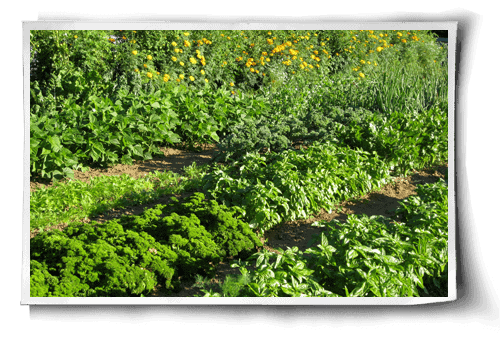 Here we planted an abundant variety of greens for green smoothies, salads and steams, as well as herbs such as parsley, basil and dill, and our very own celery, which is a real treat when it’s veganically home-grown. We also have some half-rows of sweet onions, peas, beans, carrots, beets and tomatoes.
…
Early December: (On the right you can see the rings constructed to keep the tomatoes from trailing on the ground once they start to produce. The next row down contains young beet greens at the front, and tiny carrot tops at the back, which are now being harvested.)
…
January: (The rings are no longer visible as the tomato plants have fully obscured them. You can also see how far the beets and carrots have come in just one month. And the half-row in between the beets and the beans… well, it WAS a row of arugula/rocket, but it has already been cheerfully devoured by our team of salad-munching volunteers and visitors!)
…
 Handy Hint:
* Interplant marigolds with your tomatoes or peppers to help repel pests and disease from the plants (especially nematodes in the soil). As well as being great companion plants that break up the soil with their roots, they add vibrant beauty to your garden!
 It takes a big garden patch and a lot of hard work to keep Gentle Worlders in watermelon, but we are happy to announce that our melons are almost ready for harvest.
Most people aren’t fortunate enough to be able to enjoy organic watermelon, let alone home-grown, veganic Sugar Babies! But here in Gentle World, we are serious watermelon lovers, as it is such an nutritious, cleansing, healing food that can’t be beat on a hot summer’s day.
In one of our far gardens we planted three long rows of watermelons, framed by two rows of early potatoes on either side.
…
Early December: The netted enclosures are designed to protect the plants as they’re growing… Click here for a step-by-step guide to make your own.
…
Early January:
 Here you can see the potatoes growing right through the tops of the nets, and soon after this we began to harvest them. Potatoes are harvested after the plant’s flowers have faded away. When the plant begins to wilt, that’s the sign that it’s time to dig.
…
Late January:
 (Now that some of the potatoes have been harvested the watermelons are taking over the whole patch, giving them even more room to spread out and produce more fully.)
…
February:
The next garden patch is home to our delicious sweet corn, buttercup squash, and cucumbers, along with more carrots, beets, peas and beans.
(Cucumbers are one of the easiest food plants to grow, making them a fantastic crop for beginning gardeners… Check out our collection of cucumber salad recipes for an over-abundant garden patch!)
The fence that protects this huge garden was constructed last year by Magic and a team of willing workers. Its necessity became apparent when some of our corn was destroyed by hungry intruders.
These rows of crops were planted successively, so that we can stagger our harvests to make the produce last throughout the summer.
…
Early December: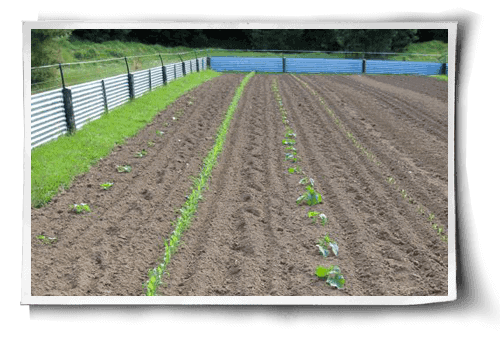 Here you can see the baby plants just starting to show above the surface of the ground… The first row of corn (a few feet from the left edge) is only a few inches high.
…
January: (Here you can see the four rows of corn at different stages of growth according to when they were planted. Four rows may seem like a lot, but – because it’s planted successively – we will be enjoying fresh corn from January until April. Also, thanks to the abundance of this garden, we were able to provide corn to the healing convention participants during our four day catering project at The Herb Shack.)
…
February:


(Here you can see the young peas, just in front of the corn. Magic recycled old wire fencing and metal posts to create a trellis for these climbing sweet peas.)
…
Late February: (Here you can see the peas making their way up the wire fence.)
…
 The trellis for these Scarlet Runners (beans), was made from tea tree posts. Here in New Zealand, the regenerating forest that surrounds our property is made up primarily of tea tree, or Manuka, which creates a canopy for the young, more diverse trees that will end up forming the majority of the forest cover, such as rimu, kauri, totara and kahikatea. The manuka doesn’t usually live very long, and when it dies in the forest, it makes fantastic firewood, as well as posts for the garden!

As you can see, the Scarlet Runner has a beautiful flower that adds a delightful splash of color to the shades of green that make up the veggie gardens.
In the next garden, we have two rows of zucchini/courgettes (planted successively), late season potatoes, kumara (NZ sweet potatoes), and heirloom tomatoes.
Early December:

Here you can hardly see anything, except for the netted enclosures to keep the plants protected. Click here for more information on constructing these enclosures.
…
January:

One month later,
the plants are already growing up to fill their protective enclosures.
The net has been taken off the kumara, so it can spread freely.
The tomatoes on the right are already growing up over their hoops, which we use to support the plants as they grow.
…
.February:

By February, the plants are nearly ready to be harvested, and we get to enjoy the results!
 Many organic farmers rely on the use of animal-based fertilizers such as manures and slaughterhouse by-products, such as blood and bone. As a result, some people question whether veganic methods are viable for large-scale food production.

But as Gentle World’s veganic growing operation clearly demonstrates, there is absolutely no reason that we need to sacrifice delicious, nutritious produce when growing food veganically.